.png)

.jpg)



Why Animal-Free Antibody Discovery Is Transforming In Vitro Diagnostics
Antibodies are the foundation of modern in vitro diagnostics (IVD). From ELISA and lateral flow assays to chemiluminescence platforms and multiplex immunoassays, the performance of diagnostic systems depends heavily on the quality of the antibodies used.
Diagnostic developers require antibodies that are highly specific, reproducible, scalable, and stable over long production cycles. However, conventional antibody discovery methods based on animal immunization often introduce limitations related to development timelines, biological variability, and access to challenging targets.
As diagnostic technologies become increasingly sophisticated, developers are looking for more controlled and reproducible approaches to antibody generation. Animal-free antibody discovery has emerged as a powerful alternative, offering faster timelines, sequence-defined reagents, and greater flexibility for difficult antigens.
Today, animal-free discovery platforms are helping reshape how antibodies are developed for next-generation diagnostics, supporting a broader movement toward reproducible, scalable, and ethically aligned biotechnology.
The Limitations of Conventional Antibody Discovery
For decades, antibody discovery has relied primarily on animal immunization. In this process, animals such as mice, rabbits, or camelids are exposed to target antigens, allowing their immune systems to generate antibodies that are later isolated and characterized.
While this approach has enabled numerous successful diagnostic products, it presents several challenges.
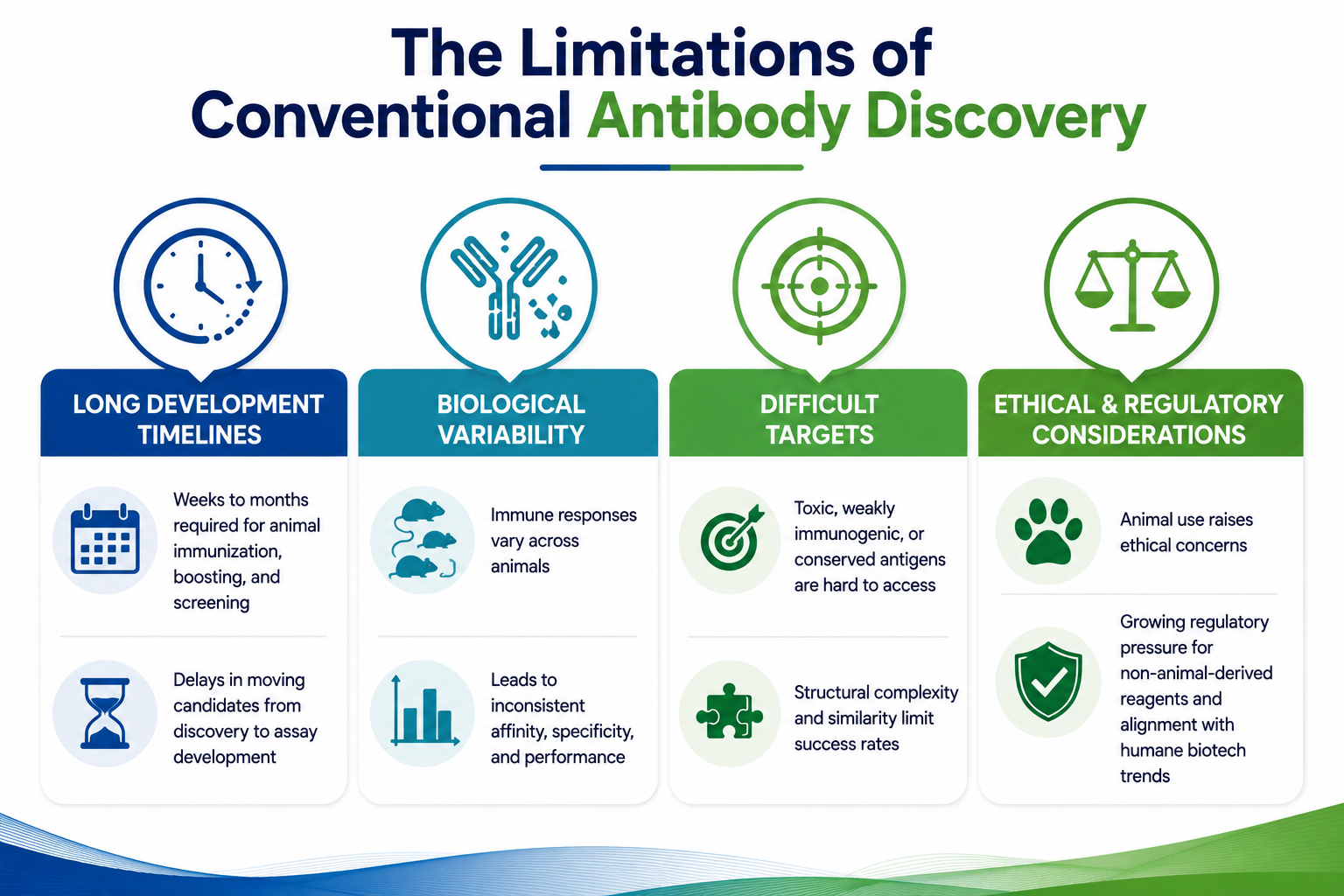
Long Development Timelines
Conventional workflows require weeks or months for immunization, boosting, and antibody maturation before candidate screening can begin. These delays can slow assay development and extend product timelines.
Biological Variability
Immune responses vary from animal to animal. Even under controlled conditions, antibody repertoires differ, leading to inconsistencies in affinity, specificity, and reproducibility.
Difficult Targets
Certain antigens are inherently challenging to address using traditional immunization approaches, including:
- Toxic proteins
- Conserved human proteins
- Weakly immunogenic targets
- Structurally unstable molecules
- Highly similar protein families
These limitations can make conventional discovery inefficient or sometimes unsuccessful.
Ethical and Regulatory Considerations
Growing interest in humane biotechnology and alternative technologies has increased demand for methods that reduce or eliminate animal use. Regulatory agencies, research institutions, and industry stakeholders are increasingly supporting non-animal approaches wherever scientifically feasible.
What Is Animal-Free Antibody Discovery?
Animal-free antibody discovery eliminates the need for immunization altogether.
Instead of relying on immune responses generated inside animals, synthetic antibody libraries containing billions of diverse sequences are screened using highly controlled in vitro selection methods.
These approaches typically employ:
- Synthetic antibody libraries
- Phage display technology
- Recombinant expression systems
- Sequence-defined screening workflows
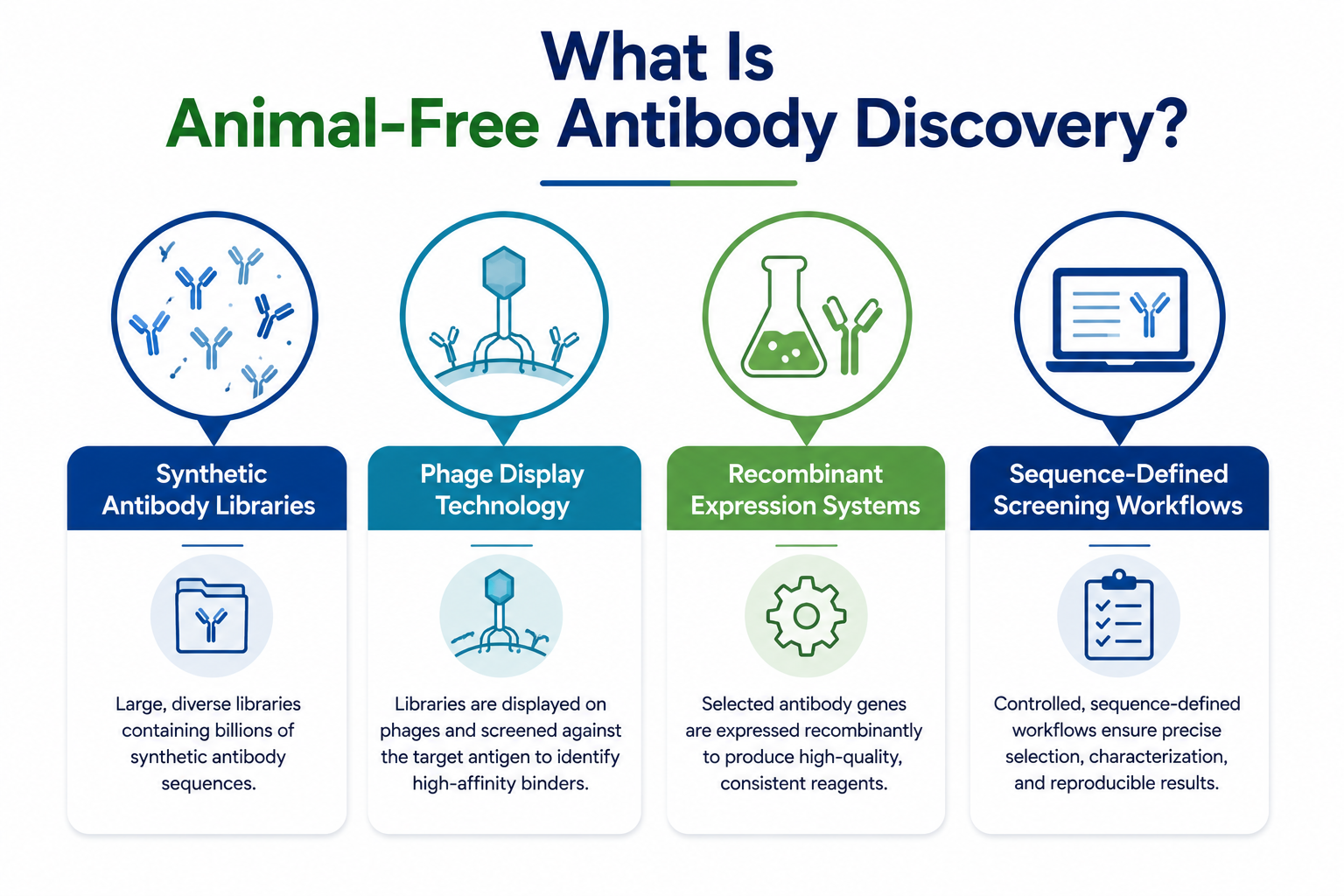
Candidate binders are selected directly against the target antigen, allowing researchers to identify antibodies with desired properties without depending on biological immune responses.
Because every selected clone is sequence-defined, the resulting reagents can be reproduced consistently across laboratories and manufacturing batches.
This level of control represents a major advantage for diagnostic development.
Why Animal-Free Discovery Is Transforming IVD
Modern diagnostic assays demand reagents that perform consistently over years of manufacturing and global deployment.
Animal-free antibody discovery addresses several critical requirements.
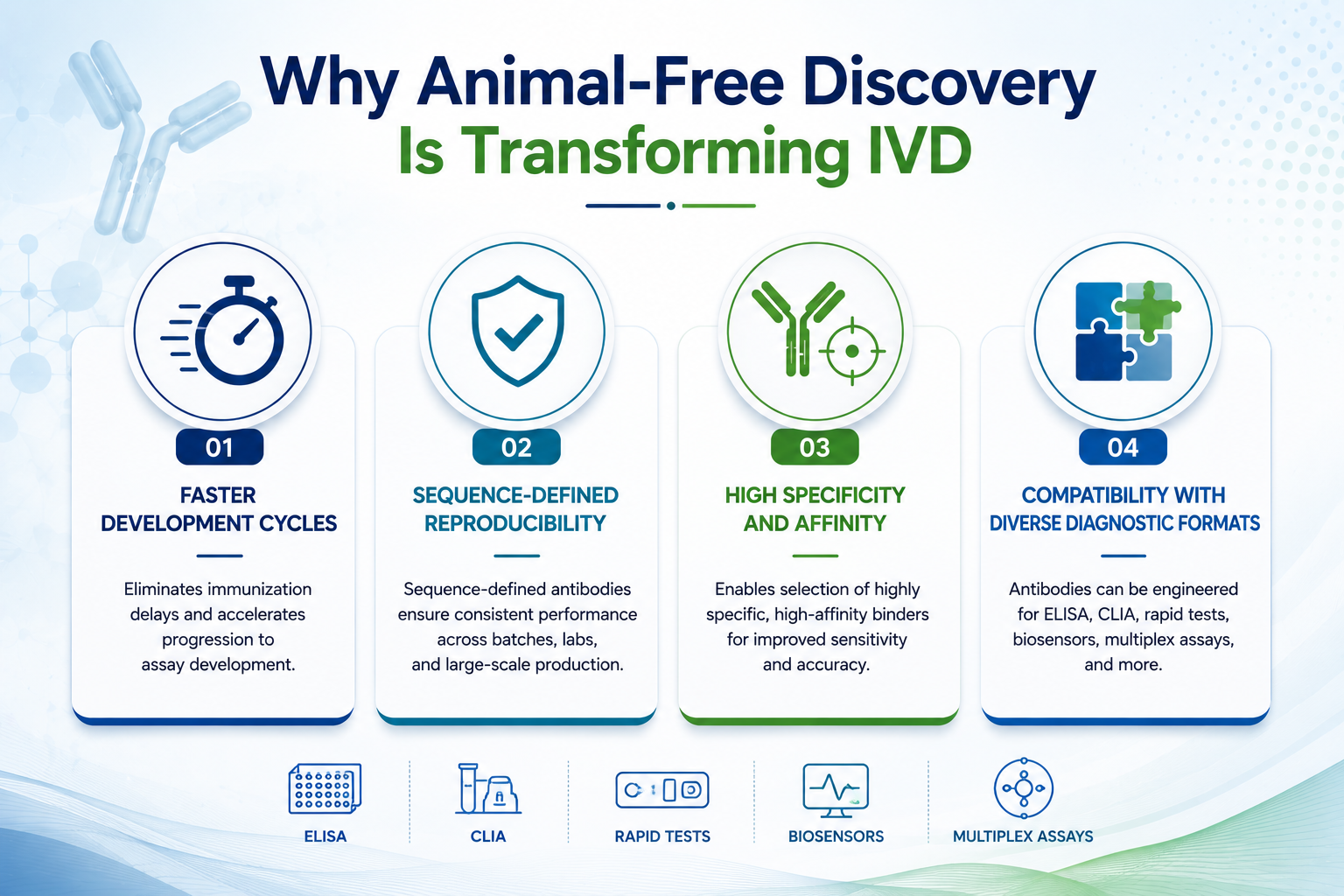
Faster Development Cycles
Traditional immunization introduces unavoidable delays. Animal-free systems bypass this bottleneck by allowing screening to begin immediately after target preparation.
As a result, discovery timelines can be significantly reduced, enabling faster transition into:
- Assay optimization
- Analytical validation
- Manufacturing scale-up
- Regulatory development
This acceleration is particularly valuable for emerging infectious diseases and rapidly evolving biomarker programs.
Sequence-Defined Reproducibility
Batch-to-batch consistency remains one of the most important factors in IVD manufacturing.
Sequence-defined recombinant antibodies provide:
- Consistent affinity profiles
- Stable assay performance
- Improved lot-to-lot reproducibility
- Reliable manufacturing scalability
This reproducibility supports long-term quality control and reduces variability throughout the product lifecycle.
High Specificity and Affinity
Synthetic selection platforms enable antibodies to be optimized for:
- High affinity
- Low cross-reactivity
- Enhanced specificity
- Improved analytical sensitivity
These characteristics are essential for reducing false positives and improving diagnostic accuracy.
Compatibility With Diverse Diagnostic Formats
Animal-free antibodies can be engineered to support multiple assay platforms, including:
- ELISA
- CLIA
- Rapid tests
- Biosensors
- Multiplex immunoassays
- Point-of-care diagnostics
Their recombinant nature also enables easier format optimization and molecular engineering.
Why VHH Antibodies Matter
Among emerging recombinant antibody formats, VHH antibodies are attracting considerable interest within diagnostics.
Also known as single-domain antibodies or nanobodies, VHHs originate from camelid heavy-chain antibodies but can be generated entirely through synthetic animal-free platforms.
Their unique structure provides several advantages.
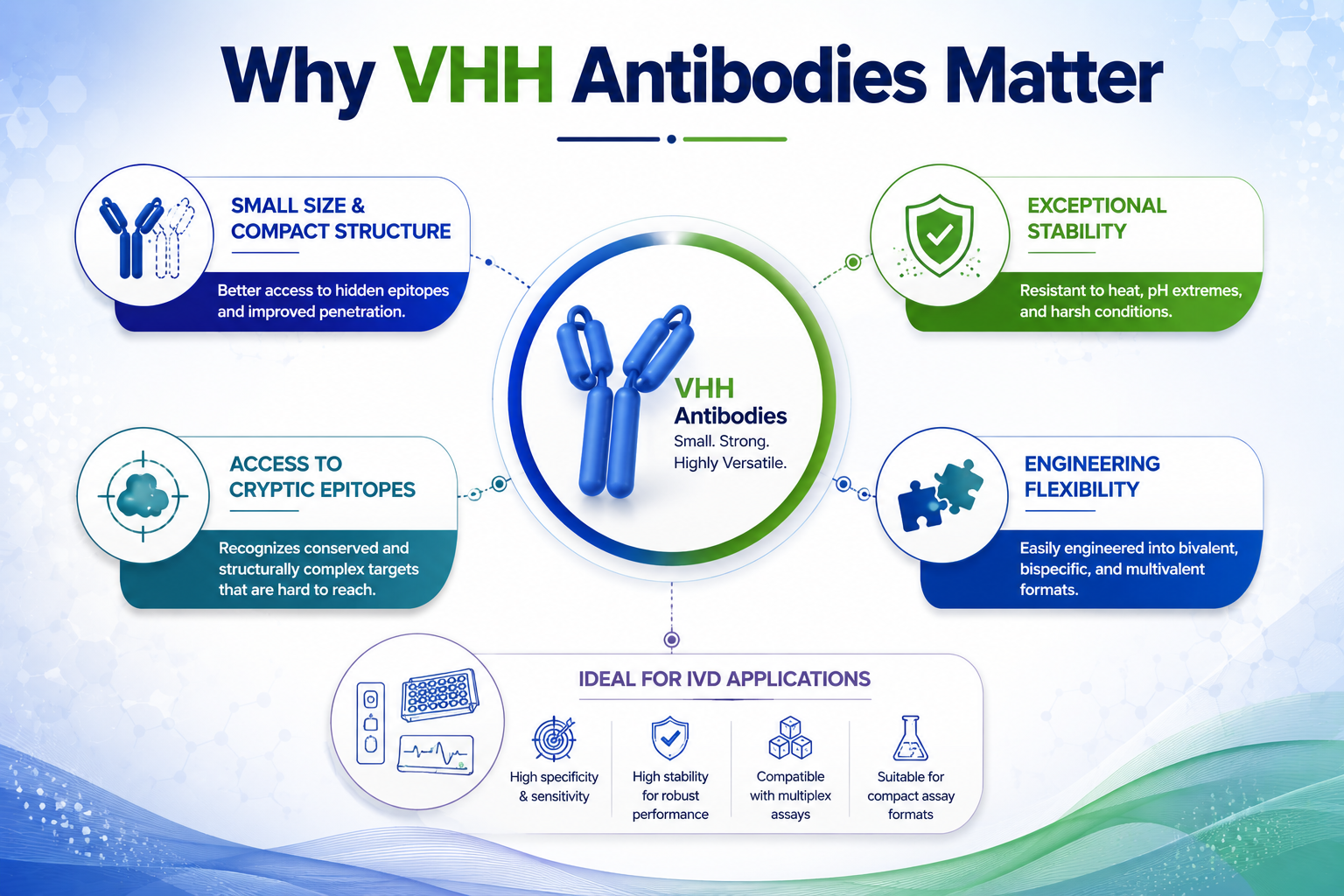
Small Size and Compact Architecture
VHH antibodies are substantially smaller than conventional IgG molecules.
Their compact structure allows:
- Better access to hidden epitopes
- Improved penetration into complex targets
- Higher surface density in assay formats
- Enhanced performance in miniaturized systems
Exceptional Stability
VHH molecules exhibit remarkable resistance to:
- Heat stress
- pH variation
- Harsh storage conditions
This stability makes them particularly attractive for:
- Point-of-care diagnostics
- Resource-limited settings
- Long shelf-life applications
Access to Cryptic Epitopes
Because of their small size, VHH antibodies can recognize epitopes inaccessible to traditional antibodies.
This capability enables targeting of:
- Conserved regions
- Conformational epitopes
- Structurally complex proteins
- Challenging biomarkers
Engineering Flexibility
VHH molecules can be readily engineered into:
- Bivalent constructs
- Bispecific formats
- Fusion proteins
- Multivalent architectures
These engineered formats provide opportunities for improving assay sensitivity and multiplexing capabilities.
The Role of VHH Antibodies in IVD Development
Animal-free VHH antibodies fit naturally into diagnostic workflows.
They can serve as:
Primary Capture Reagents
Highly specific binders enable efficient target capture and improved assay sensitivity.
Detection Antibodies
Stable and sequence-defined reagents support consistent signal generation.
Multiplex Panels
Small size and engineering flexibility make VHH molecules suitable for high-density multiplex systems.
Quality Control Standards
Recombinant sequence-defined antibodies contribute to long-term manufacturing consistency and assay reproducibility.
Their adaptability makes them increasingly valuable across modern immunodiagnostic platforms.
YBL-Vega: Accelerating Animal-Free Antibody Discovery
As the demand for recombinant diagnostic reagents grows, platforms capable of delivering rapid and reproducible antibody discovery become increasingly important.
Yashraj Biotechnology's YBL-Vega platform represents a fully animal-free discovery approach designed to support diagnostic and research applications.

The platform combines:
- Large synthetic library diversity
- Phage display screening
- Sequence-defined binder selection
- Flexible antibody formats
- Rapid discovery workflows
By eliminating immunization requirements, YBL-Vega enables accelerated discovery cycles, often delivering candidate binders within 8–10 weeks.
The platform is particularly useful for challenging targets such as:
- Toxic proteins
- Weakly immunogenic antigens
- Highly conserved proteins
- Structurally complex molecules
Its flexibility allows antibodies to be generated and optimized for multiple IVD applications while maintaining consistency across development and manufacturing.
Conclusion: Building the Future of Diagnostic Antibody Discovery
The evolution of in vitro diagnostics is placing unprecedented demands on antibody reagents. Diagnostic developers today require more than high affinity alone—they need reagents that are reproducible, scalable, sequence-defined, and capable of supporting increasingly sophisticated assay formats.
Traditional immunization-based workflows have served the industry well for decades, but their inherent limitations in speed, variability, and target accessibility are driving the adoption of next-generation discovery approaches.
Animal-free antibody technologies are addressing these challenges by enabling highly controlled, reproducible, and accelerated discovery processes that align with modern diagnostic requirements.
At the same time, advanced formats such as VHH antibodies are expanding the possibilities for assay design. Their small size, exceptional stability, and ability to recognize challenging epitopes make them particularly attractive for multiplex diagnostics, point-of-care platforms, and engineered reagent formats.
As regulatory expectations, manufacturing requirements, and ethical considerations continue to evolve, sequence-defined recombinant antibodies are becoming increasingly important for ensuring long-term assay consistency and global scalability.
Platforms such as YBL-Vega demonstrate how animal-free discovery can accelerate antibody generation while enabling solutions for toxic, weakly immunogenic, and structurally complex targets. By combining synthetic library diversity with flexible screening strategies, these technologies are helping redefine how diagnostic reagents are developed.
The future of IVD will increasingly belong to organizations that prioritize reproducibility, speed, and human-centric innovation. Animal-free antibody discovery is no longer simply an alternative to conventional methods—it is emerging as a strategic foundation for the next generation of precision diagnostics.