.jpg)


Cellular Time Travel: How iPSCs Are Revolutionizing the Hunt for New Drugs
What is iPSC Technology?
Imagine if you could scrape a tiny piece of skin from your arm, put it in a petri dish, and hit a biological “rewind” button. Within a few weeks, those skin cells forget they were ever skin. They revert into a blank slate—a master cell that can be coaxed into becoming literally anything else: a beating heart cell, a firing brain neuron, or a liver cell.
This isn't science fiction. It’s a Nobel Prize-winning breakthrough called iPSC technology (Induced Pluripotent Stem Cells), and it is fundamentally changing how we discover and test new medicines.
If you’ve ever wondered why drug discovery takes so long, costs so much, and fails so often, you’re not alone. Let’s talk about why the old way of doing things is broken, and how iPSCs are stepping in to fix it.
The Problem: Mice Aren't Humans
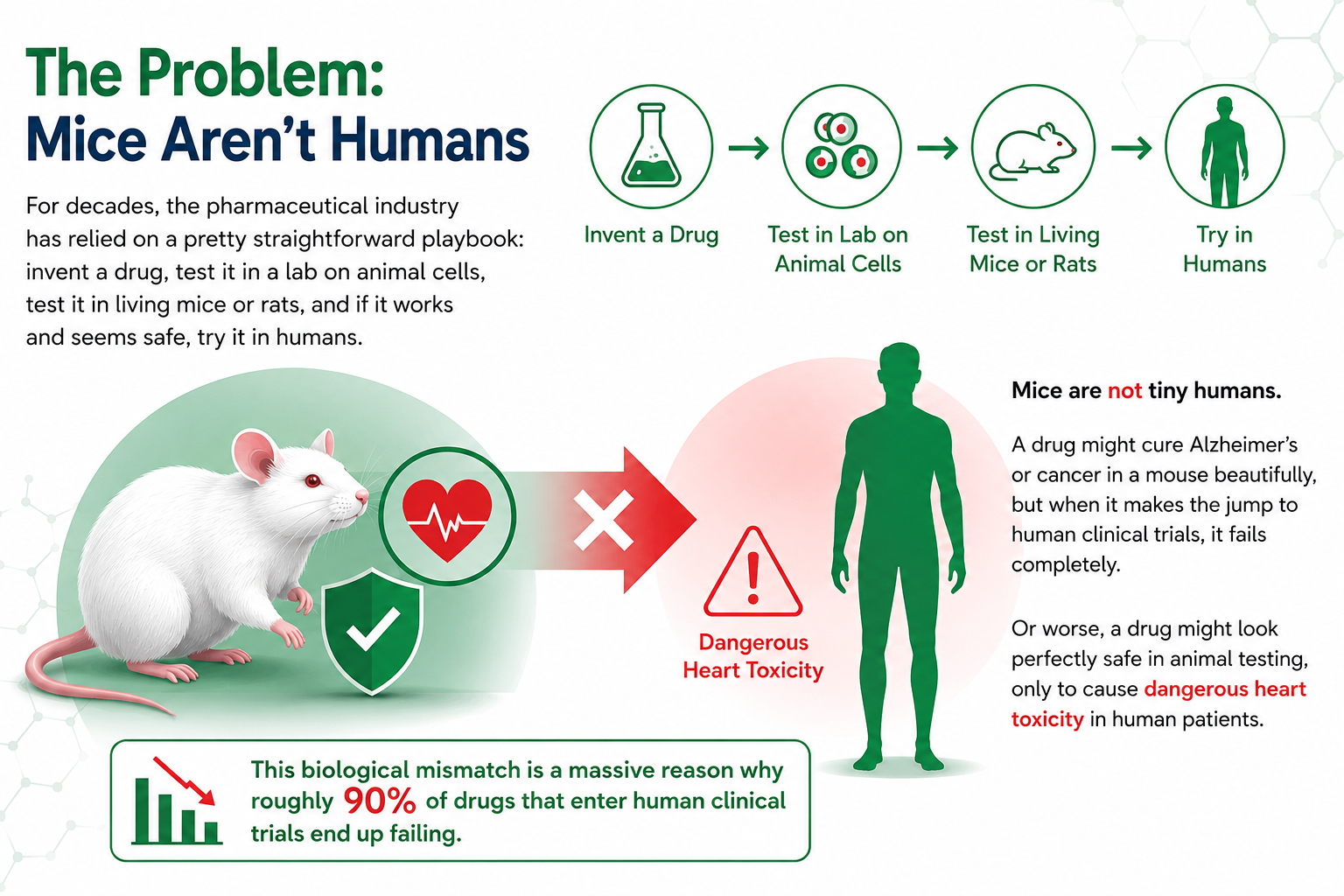
For decades, the pharmaceutical industry has relied on a pretty straightforward playbook: invent a drug, test it in a lab on animal cells, test it in living mice or rats, and if it works and seems safe, try it in humans.
But there’s a massive roadblock here. Mice are not tiny humans.
A drug might cure Alzheimer's or cancer in a mouse beautifully, but when it makes the jump to human clinical trials, it fails completely. Or worse, a drug might look perfectly safe in animal testing, only to cause dangerous heart toxicity in human patients. This biological mismatch is a massive reason why roughly 90% of drugs that enter human clinical trials end up failing.
The iPSC Solution: “Disease in a Dish”
This is where iPSCs come to the rescue. Because we can take a blood or skin sample from a patient with a specific disease and turn those cells into stem cells, we can now grow their exact disease in a laboratory dish.
Here’s why that is a total game-changer for drug discovery:
Testing on Human Biology
Instead of guessing how a drug affects a human heart by looking at a mouse heart, scientists can test the drug on actual, beating human heart cells grown from iPSCs.
Access to the Inaccessible
You can’t exactly biopsy a living patient's brain to study Parkinson’s disease. But with iPSCs, you can make it from their skin cell or blood, turn it into a stem cell, and then grow their specific brain neurons in a dish to study how the disease works.
Personalized Medicine
Because the cells share the exact DNA of the patient, scientists can test hundreds of drugs on a patient's cells to see which one works best for them before writing a prescription.

From Lab to Clinic: Real-World Case Studies
It’s one thing to talk about the potential of iPSCs, but it’s another to see it in action. Are there drugs discovered or validated using this technology that have actually made it to human clinical trials? Absolutely. Here are a few incredible examples:
1. Ropinirole for ALS (Lou Gehrig’s Disease)
ALS is a devastating and fatal disease that destroys motor neurons—the nerve cells that control muscles. Finding drugs for it has been notoriously difficult.
Researchers in Japan took cells from ALS patients, reverted them to iPSCs, and then grew them into motor neurons. They watched these lab-grown neurons get sick and die, mimicking the disease. Then, they screened over 1,200 existing drugs on these cells to see if anything could stop the cell death.
They found a surprising winner: Ropinirole, a drug originally used to treat Parkinson's disease. Because this discovery was made using actual human ALS cells, the drug was fast-tracked into clinical trials. Recent trial results showed that it safely delayed the progression of the disease in patients who responded to it.
.png)
2. Rapamycin for FOP (Stone Man Syndrome)
FOP (Fibrodysplasia Ossificans Progressiva) is an ultra-rare, tragic genetic disorder where muscles and soft tissues gradually turn into bone.
Because it is so rare, it’s incredibly hard to find enough patients to study the disease, let alone test drugs. Scientists at Kyoto University used iPSCs derived from FOP patients to create models of the disease in the lab.
Through this “disease in a dish” model, they screened libraries of compounds and discovered that an existing immunosuppressant drug called Rapamycin successfully blocked the abnormal bone formation. This iPSC-driven discovery led directly to an investigator-initiated clinical trial to test Rapamycin in human FOP patients.
.png)
3. Statins for Achondroplasia (Dwarfism)
Achondroplasia is the most common form of short-limbed dwarfism, caused by a genetic mutation that halts cartilage from turning into bone.
Researchers created iPSCs from patients with this condition and grew them into cartilage-producing cells. By screening drugs on these lab-grown cells, they made a shocking discovery: Statins, a class of highly common, FDA-approved drugs used to lower cholesterol, actually rescued the bone-growth defects in the cells.
Because statins are already known to be safe in humans, this finding rapidly paved the way for clinical trials in Japan to see if statins can safely promote bone growth in children with the condition.
.png)
The Future is Human-First
We are sitting at the edge of a massive shift in medicine. While we won't eliminate animal testing overnight, iPSCs are allowing us to pivot toward a “human-first” approach to drug discovery.
By capturing human diversity and human diseases in a petri dish, we are making the hunt for cures faster, safer, and much more accurate. The biological rewinding of cells isn't just a cool lab trick anymore; it is actively putting life-saving drugs into clinical trials today.