.jpg)



The Architecture of Modern Translation: Decoding the Strategic Shift to New Approach Methodologies (NAMs)
Introduction: Closing the Translational Gap in Drug Development
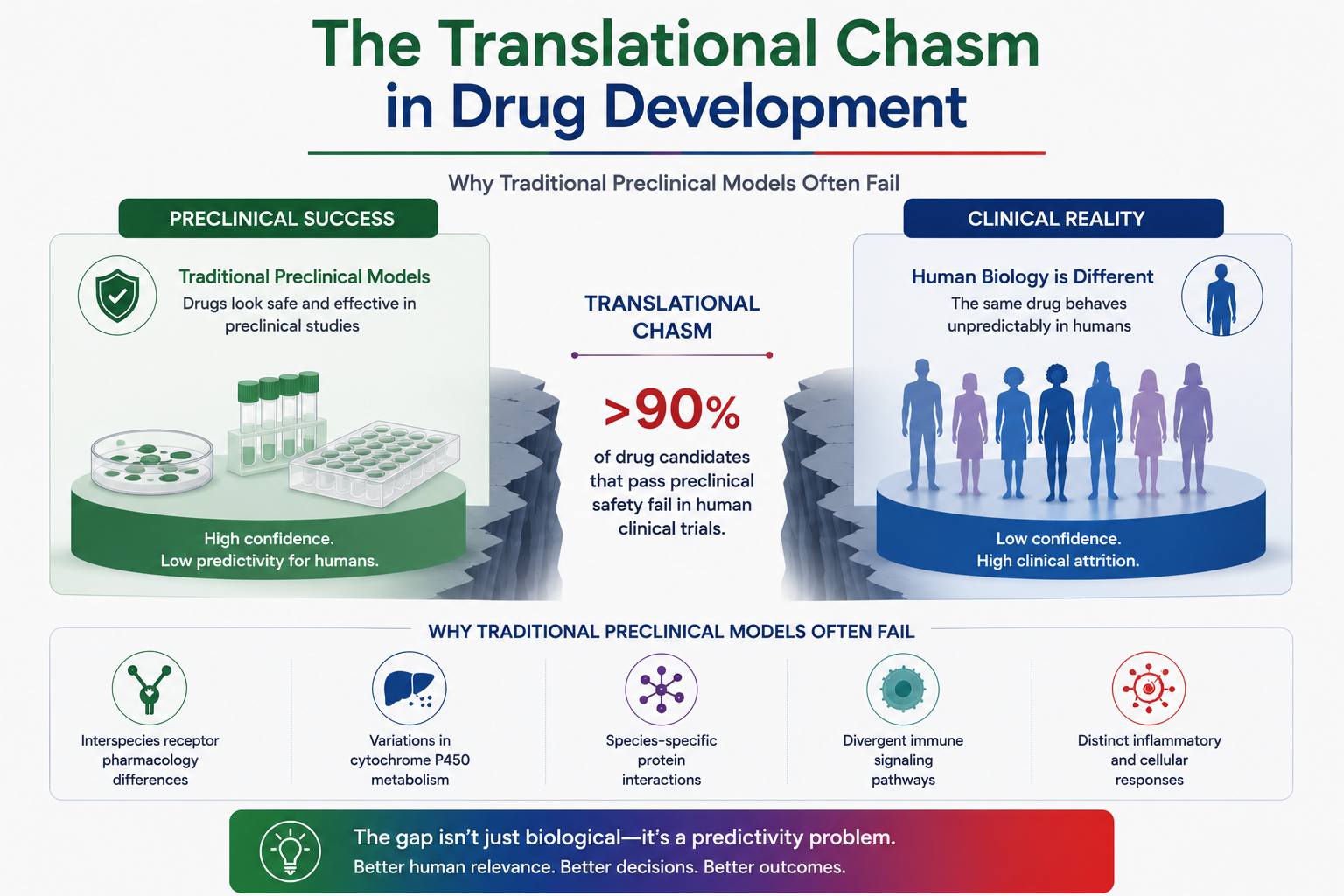
Modern drug discovery is entering a decisive transition phase. For decades, pharmaceutical R&D has relied heavily on conventional preclinical animal models to evaluate drug safety and efficacy before human clinical trials. Yet despite significant advances in molecular biology, computational chemistry, and translational medicine, one challenge continues to define the economics of drug development: more than 90% of investigational therapies that successfully pass preclinical testing ultimately fail during clinical development.
Increasingly, researchers, regulators, and biopharma leaders no longer view this as an unavoidable cost of innovation. Instead, it is being recognized as a problem of biological predictability and data fidelity.
New Approach Methodologies (NAMs) are emerging as a scientific framework designed to close this translational gap by generating earlier, more human-relevant, and decision-ready biological data. Regulatory pathways, computational infrastructure, and advanced biological systems supporting NAM-driven drug development are actively evolving across the global pharmaceutical ecosystem.
For organizations focused on Integrated Drug Discovery (IDD), translational science, and regulatory innovation, NAMs are rapidly becoming a foundational strategic capability rather than an experimental alternative.
The Translational Chasm in Drug Development
Why Traditional Preclinical Models Often Fail
One of the biggest challenges in modern drug development is the disconnect between preclinical success and clinical reality.
Traditional animal models remain valuable for mechanistic insight and toxicology screening. However, even highly optimized animal systems cannot fully replicate the complexity of human biology.
A therapeutic candidate that appears safe and effective in preclinical studies may behave unpredictably in humans due to:
- Interspecies receptor pharmacology differences
- Variations in cytochrome P450 metabolism
- Species-specific protein interactions
- Divergent immune signaling pathways
- Distinct inflammatory and cellular responses
This creates a translational gap between laboratory confidence and human clinical predictability.
The growing adoption of NAMs reflects an industry-wide effort to improve the relevance of preclinical evidence and reduce the uncertainty that often emerges during clinical development.
NAMs: A Human-Predictive Biological Architecture
NAMs should not be viewed simply as alternatives to animal testing. They represent a broader scientific architecture designed to improve:
- Predictive toxicology
- Human biological relevance
- Mechanistic understanding
- Translational confidence
- Regulatory decision-making
The FDA broadly defines NAMs to include:
- Advanced in vitro systems
- 2D and 3D cell-based assays
- In chemico methodologies
- In silico computational models
Importantly, regulators increasingly evaluate NAM-generated evidence within a weight-of-evidence framework rather than rigid one-to-one replacement models. This marks a significant shift in how preclinical evidence is generated and assessed.
Defining the NAMs Toolkit
Modern NAMs function as interconnected scientific systems combining:
- Human-derived cellular platforms
- Computational toxicology
- AI-driven prediction
- Pharmacokinetic modeling
- Advanced biochemical characterization
Rather than acting as isolated testing methods, they create a coordinated translational framework that supports candidate prioritization, mechanistic toxicology, exposure prediction, and regulatory evidence generation.
Pillar 1: Advanced In Vitro & Microphysiological Systems (MPS)
One of the most important developments in translational science is the rise of human-relevant microphysiological systems.
These include:
- 3D cell culture systems
- Patient-derived organoids
- Organ-on-a-chip technologies
- Complex multicellular co-culture models
Unlike traditional two-dimensional assays, these systems better replicate tissue architecture, cellular signaling, mechanical stress responses, and human physiological microenvironments.
The FDA has emphasized the importance of biological relevance when selecting cell types, tissue architecture, and physiological functionality in NAM systems. Human-relevant models allow researchers to observe drug responses under conditions that more closely resemble clinical biology.
.png)
Pillar 2: In Silico and Computational Foresight
Computational biology now plays a central role in predictive drug development.
NAM-driven computational systems include:
- Machine learning toxicology models
- AI-driven molecular prediction tools
- Physiologically Based Pharmacokinetic (PBPK) modeling
- Predictive exposure simulations
- Virtual screening systems
These technologies help researchers prioritize compounds earlier, predict metabolic liabilities, simulate human pharmacokinetics, and reduce unnecessary downstream testing.
As computational infrastructure advances, in silico systems are becoming increasingly valuable for generating regulatory-grade evidence and supporting translational decision-making.

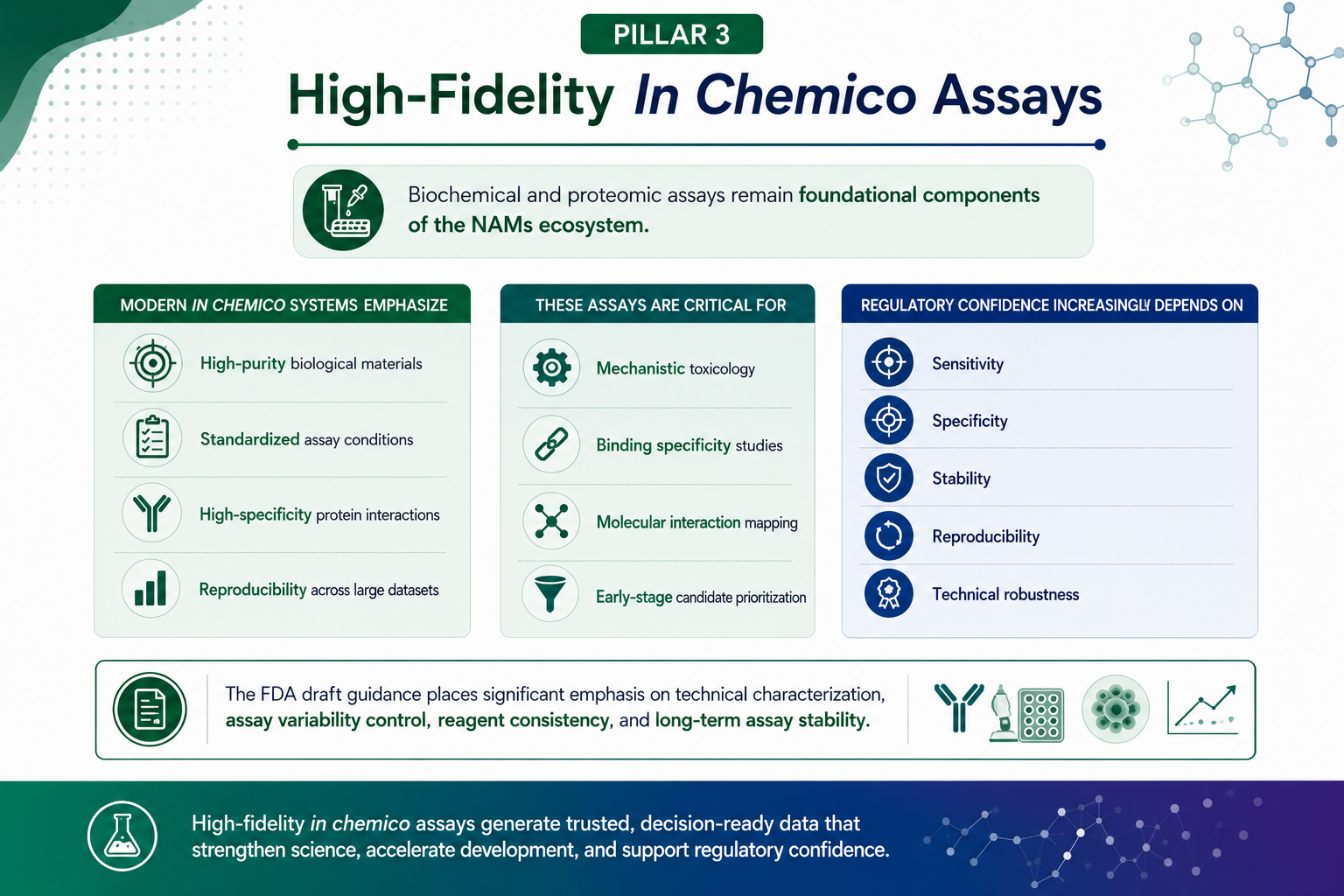
Pillar 3: High-Fidelity In Chemico Assays
Biochemical and proteomic assays remain foundational components of the NAM ecosystem.
Modern in chemico systems emphasize:
- High-purity biological materials
- Standardized assay conditions
- High-specificity protein interactions
- Reproducibility across large datasets
These assays are critical for mechanistic toxicology, binding specificity studies, molecular interaction mapping, and candidate prioritization.
Regulatory confidence increasingly depends on demonstrating sensitivity, specificity, stability, reproducibility, and technical robustness. Consequently, assay characterization and reagent consistency are becoming essential elements of NAM-based development strategies.
The Regulatory Watershed: NAMs Move Into Mainstream Drug Development
Regulators Are Reshaping the Definition of Evidence
One of the most significant developments in the NAM landscape is regulatory evolution.
For decades, preclinical development followed established animal-testing paradigms because they represented the clearest path to regulatory acceptance. Today, agencies are increasingly adopting more flexible, evidence-driven approaches that prioritize:
- Human biological relevance
- Mechanistic understanding
- Predictive validity
- Data reproducibility
- Context-of-use applicability
This reflects growing recognition that advanced human-relevant systems may provide more clinically predictive information than traditional animal models alone.
Human Biological Relevance Is Becoming Central to Regulatory Confidence
A major theme throughout the FDA guidance is the importance of demonstrating human biological relevance.
Developers are increasingly expected to show that their models accurately reflect:
- Human physiology
- Tissue functionality
- Disease-relevant biology
- Mechanistic toxicology endpoints
This has increased the strategic importance of:
- Organoid systems
- Organ-on-chip technologies
- Human-derived cellular models
- Mechanistic biomarker assays
As regulatory science evolves, confidence is increasingly based on how well a model reflects human biology rather than how closely it mirrors historical testing approaches.
Global Regulatory Alignment Is Accelerating
The movement toward NAMs extends beyond the United States.
Organizations including the UK MHRA, EMA, ECHA, and OECD are increasingly supporting human-relevant testing strategies, computational toxicology, and integrated evidence frameworks.
This growing international alignment suggests that NAM-generated evidence will become increasingly valuable across global development programs.
For biopharma organizations, the message is clear: regulators are no longer simply open to alternative data packages—they are actively developing frameworks that define how those data should be generated, validated, and submitted.
The Golden Thread: Why Reproducibility and Material Purity Matter
Advanced Systems Are Only as Reliable as Their Inputs
As NAM platforms become more sophisticated, biological reproducibility becomes increasingly important.
Advanced systems such as:
- Organ-on-chip platforms
- Human co-culture systems
- Recombinant protein assays
- Proteomic interaction models
are highly sensitive to variability in their biological materials.
Even small inconsistencies in antigens, antibodies, cell lines, growth factors, or specialized proteins can distort downstream results.
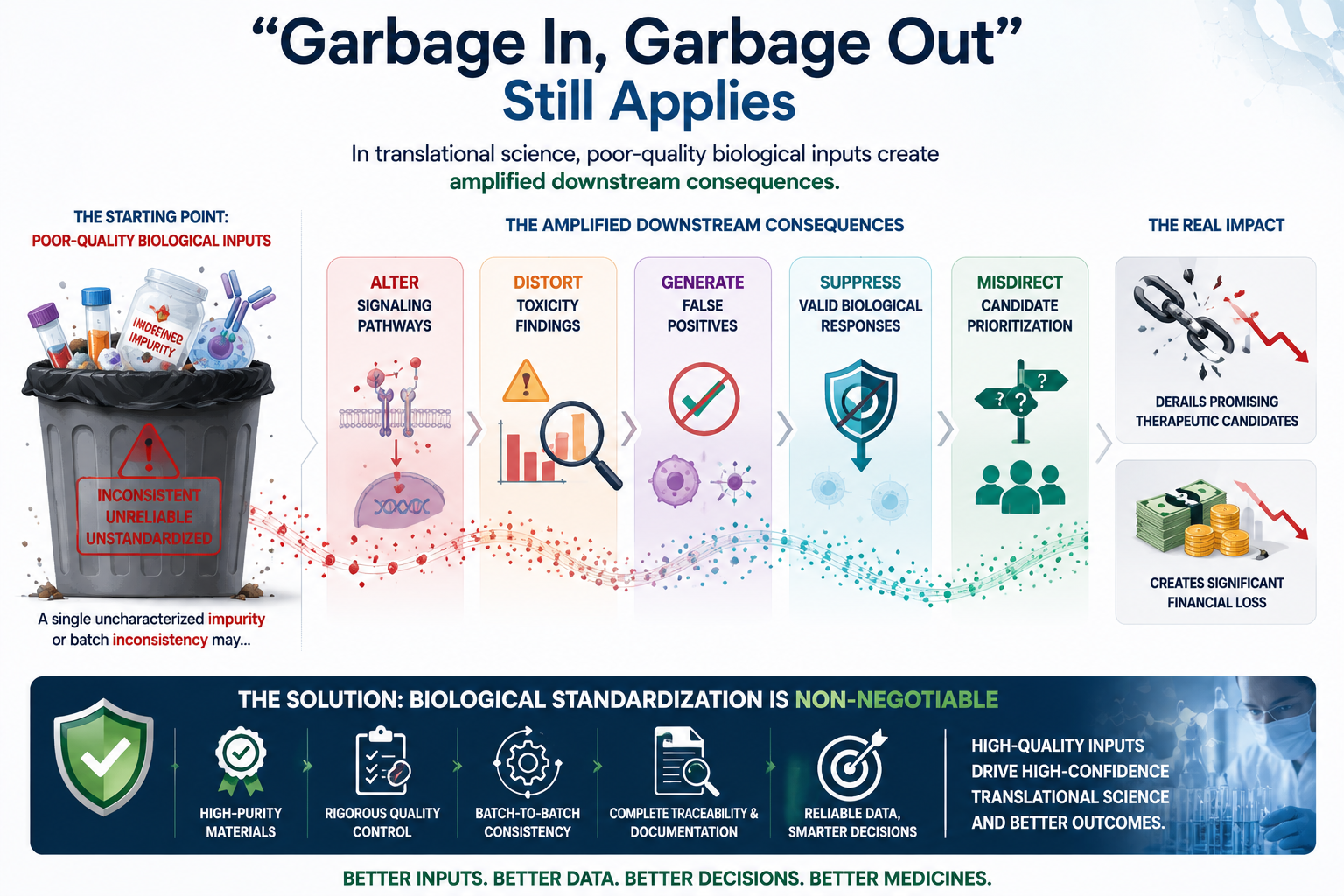
“Garbage In, Garbage Out” Still Applies
In translational science, poor-quality biological inputs create amplified downstream consequences.
A single uncharacterized impurity or batch inconsistency may:
- Alter signaling pathways
- Distort toxicity findings
- Generate false positives
- Suppress valid biological responses
- Misdirect candidate prioritization
In high-cost drug development programs, this can derail promising therapeutic candidates and create significant financial loss.
For NAMs to achieve industrial scalability, biological standardization becomes non-negotiable.
The Operational Foundation of Scalable NAMs
Achieving regulatory-grade reproducibility requires:
- Rigorous Quality Management Systems (QMS)
- Biological traceability frameworks
- Standardized assay conditions
- Controlled sourcing systems
- Batch-to-batch consistency monitoring
- Stability characterization protocols
Organizations supporting advanced diagnostic and research ecosystems increasingly recognize that high-integrity biological inputs are essential for generating trustworthy translational data.
At Yashraj Biotechnology, the emphasis on scientifically standardized biological systems reflects the broader industry movement toward reproducibility-driven translational science and dependable research infrastructure.
Conclusion: Building High-Conviction Drug Discovery Pipelines
The adoption of New Approach Methodologies is no longer solely a scientific discussion. It is becoming a strategic business advantage.
By integrating NAMs early into the Integrated Drug Discovery process, organizations can generate more human-relevant and mechanistically informed data before entering costly clinical stages. This helps:
- Reduce downstream attrition
- Improve candidate prioritization
- Accelerate IND preparation timelines
- Optimize R&D resource allocation
- Strengthen regulatory submissions
- Build higher-confidence development portfolios
Beyond operational efficiency, stronger translational data improves portfolio quality and enhances opportunities for strategic partnerships and investment.
The transition toward human-predictive drug development is already underway. Advanced in vitro systems, computational modeling platforms, and mechanistic translational tools are becoming part of modern regulatory and scientific infrastructure.
The future of drug discovery will increasingly belong to organizations that build their pipelines on a foundation of human-relevant biology, reproducible data generation, mechanistic insight, and regulatory-aligned scientific systems.
In an increasingly data-driven pharmaceutical landscape, the ability to generate reliable, decision-ready, human-predictive evidence will become a defining factor in both scientific and commercial success.